
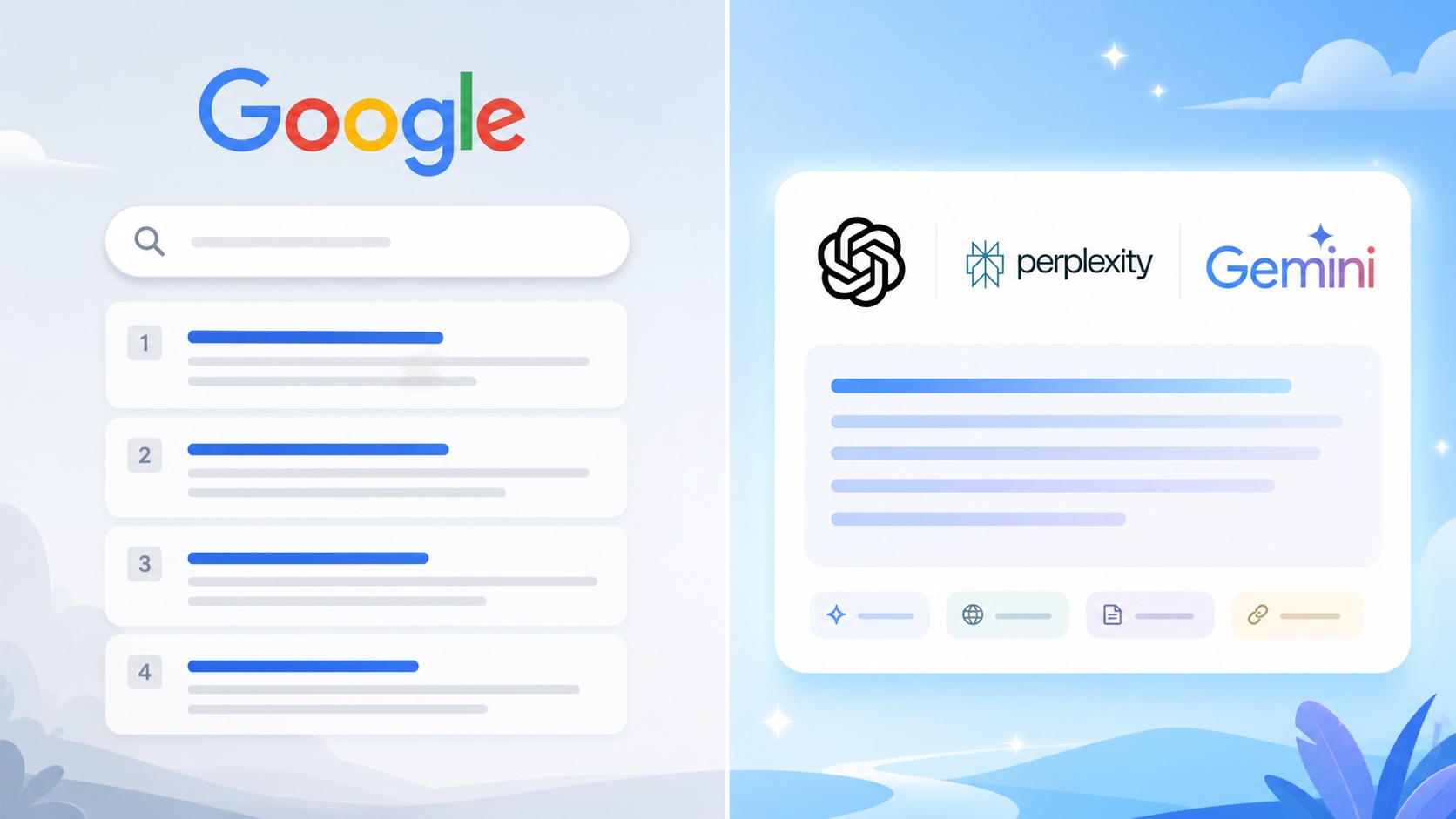
AI SEO vs Traditional SEO: What Actually Changed in 2026
Your Google Ranking Doesn't Matter Anymore
For fifteen years, the game was simple: get to the top of Google's ten blue links. In 2026, many of your customers don't even see that list. They get their answers directly from an AI, and your business is either the source of that answer or it’s invisible.
This is the shift from traditional Search Engine Optimization (SEO) to AI Engine Optimization (AEO), sometimes called Generative Engine Optimization (GEO). It’s not an update, it’s a replacement. Traditional SEO aimed to rank a page. AI SEO aims to become a trusted, citable source for AI models like Google's AI Overviews, Perplexity, ChatGPT, and Claude.
If your marketing strategy still revolves around keyword density and backlinks, you're fighting yesterday's war.
What is Traditional SEO?
Traditional SEO was a set of practices designed to convince Google's crawlers that your webpage was the most relevant result for a specific keyword. It was a technical game played against an algorithm.
The primary components were:
* On-Page SEO: Optimizing individual page elements. This included things like title tags, meta descriptions, header tags (H1, H2), image alt text, and internal linking. The core idea was to signal to Google what the page was about. * Keyword Research: Using tools to find terms people were searching for, analyzing their volume and difficulty, and then creating content that matched those terms. * Off-Page SEO (Link Building): Acquiring hyperlinks from other websites to your own. Google viewed these links as votes of confidence, a major factor in its PageRank algorithm. More high-quality links meant more authority. * Technical SEO: Ensuring a site was crawlable and indexed correctly. This involved sitemaps, robots.txt files, site speed, and mobile-friendliness.
The entire process was about climbing a ranked list. The goal was position #1. Everything else was secondary.
What is AI SEO (or GEO)?
AI SEO is not about ranking a page. It's about making your business's data, expertise, and information the direct source for answers provided by generative AI models.
When a user asks, "What's the best med spa in Miami for Morpheus8 treatments?" Google's AI Overview or Perplexity doesn't show them a list of ten websites to click. It synthesizes an answer directly. AI SEO is the work of making sure your business is cited in that synthesized answer.
The core components look different:
* Factual Accuracy and E-E-A-T: AI models are under immense pressure to be accurate. They prioritize sources that demonstrate Experience, Expertise, Authoritativeness, and Trustworthiness (E-E-A-T). Vague claims are ignored. Specific, verifiable facts are indexed and cited. * Structured Data: Using schemas (like Schema.org) to label your data so machines can understand it perfectly. This means marking up your address, hours, services, prices, and reviews in a machine-readable format. * Knowledge Graph and Entity SEO: It's not about keywords, it's about entities. An "entity" is a specific person, place, or thing. AI SEO focuses on building a clear, consistent profile for your business entity across the web, from your website to Google Business Profile to industry directories. * Citation and Sourcing: Getting your business mentioned as an authority on other trusted websites, in research, and in data sets. The AI looks for consensus among reliable sources.
The goal of AI SEO is not to be #1 on a list. The goal is to be the answer.
The Turning Point: Why SEO Changed in May 2026
The final phase of Google's AI Overviews rollout in May 2026 was the tipping point. Before this, AI chat was a separate tool. Now, it's the default search experience for a massive segment of queries.
A study from Search Engine Land published in late May 2026 showed that for commercial-intent queries, click-through rates to traditional organic listings dropped by as much as 25% in categories where AI Overviews were dominant. Users got their answer and never scrolled down.
This isn't just Google. The user interface of Perplexity, the continued integration of ChatGPT with search, and Meta's AI providing recommendations within Instagram and Facebook have created a new information ecosystem. Your customers are asking questions and getting answers without ever visiting a traditional search results page.
Key Differences: A Head-to-Head Comparison
| Feature | Traditional SEO | AI SEO (GEO) |
|---|---|---|
| Primary Goal | Rank #1 on a search engine results page (SERP). | Become a cited source in an AI-generated answer. |
| Core Metric | Keyword ranking, organic traffic. | Citations, brand mentions in AI answers, direct leads. |
| Content Focus | Long-form, keyword-optimized blog posts. | Factual, data-rich, easily verifiable content snippets. |
| Technical Focus | Site speed, mobile-friendliness, crawlability. | Structured data (Schema), knowledge graph optimization. |
| "Authority" Signal | Backlinks from other websites. | Factual consensus across multiple high-trust sources. |
| User Interaction | User clicks a link to visit your website. | User gets their answer directly from the AI, may click a citation link. |
Florida Business Example 1: An HVAC Company in Melbourne
A client of ours, an HVAC company in Melbourne, Florida, used to rely on traditional SEO. They ranked #2 for "ac repair melbourne fl". They got decent traffic, but their lead quality was inconsistent. Many visitors were just price shopping or looking for DIY tips.
The Old Way (Traditional SEO): They had a 2,000-word blog post titled "10 Signs You Need AC Repair in Melbourne FL". It was stuffed with keywords. It got traffic, but a low conversion rate.
The New Way (AI SEO): We shifted their strategy. Instead of a long blog post, we focused on creating clear, factual data points.
1. Service Area Entity: We used structured data to define their service area precisely, not just as a list of towns, but with geo-coordinates for Brevard County. 2. Service Schemas: We marked up each service ("AC Tune-Up," "Duct Cleaning," "Emergency Repair") with its exact price, duration, and the specific models they serviced (Trane, Carrier, etc.). 3. Factual FAQs: We replaced the blog post with a database of specific questions and answers. Instead of "How often should I service my AC?", the entry became: "The Department of Energy recommends annual HVAC servicing. For Florida's high-humidity climate, Mi Assist Studio recommends biannual checks for units older than 5 years to prevent mold buildup."
The Result: Three months later, a search on Perplexity for "cost of an AC tune-up for a Trane unit in Melbourne, Florida" cites our client's website directly in the generated answer, including the price. They get fewer website visitors, but the leads that come in are pre-qualified. They know the price and the service details. Their booking rate from web leads has increased by 40% while overall traffic has slightly decreased. They are winning business, not just traffic.
Florida Business Example 2: A Med Spa in Miami
A Miami-based med spa was spending thousands on Google Ads and traditional SEO to rank for "botox miami". The competition was fierce, and the cost-per-click was unsustainable.
The Old Way (Traditional SEO): They focused on a beautiful gallery page and blog posts about the benefits of Botox. They were competing with hundreds of other med spas on the exact same keywords.
The New Way (AI SEO): We focused on becoming an undeniable authority on a specific, high-value niche.
1. Practitioner Schema: We marked up the lead practitioner's credentials, including her medical license number, the year she was certified, and links to her publications. This builds entity trust. 2. Treatment-Specific Data: Instead of just "Botox," we created detailed pages for "Botox for Crow's Feet," "Botox for Forehead Lines," etc. Each page included the exact number of units typically used, the brand name (e.g., Allergan BOTOX® Cosmetic), the expected duration of results based on clinical studies, and the contraindications. 3. Review Syndication: We used GoHighLevel to automate review requests and ensured positive reviews on Google, Yelp, and industry sites all mentioned specific treatments. This creates a factual consensus that the AI can verify.
The Result: When a user now asks Google's AI, "Which Miami med spa has the most experienced practitioner for treating forehead lines with Botox?", the AI Overview synthesizes an answer that highlights our client's lead practitioner. It cites her credentials and the specific details from the website. The citation is more valuable than a #1 ranking because it comes with an implicit AI endorsement. Their cost-per-acquisition for new Botox patients dropped by over 60%.
How We Implement an AI SEO Strategy
Pivoting from traditional SEO to AI SEO is not about deleting your blog. It's about restructuring your digital presence around facts, not keywords.
Our Process at Mi Assist Studio:
1. Entity Audit: We first define your business as an entity. We audit your online presence, from your Google Business Profile to your social media to local directories, ensuring 100% consistency in your name, address, phone number, and services. 2. Structured Data Implementation: We go through your entire website and wrap key information, services, products, prices, and people in the appropriate Schema.org markup. This is the language the machines speak. 3. Content Restructuring: We identify your core expertise and convert it into a knowledge base of factual, citable snippets. We prioritize data, numbers, and processes over long narrative content. 4. Reputation Management: We use tools like GoHighLevel to build a steady stream of authentic reviews that mention specific services. This provides the social proof and factual consensus that AI models look for. 5. Knowledge Graph Feeds: We submit your core business data directly to the key knowledge graphs, including Google's, to ensure they have the most accurate and up-to-date information.
This is a systematic, technical process. It's less about creative writing and more about architectural precision. The goal is to make your business the most reliable and easily understood source of information in your niche and location.
The world of ten blue links is over. Your customers are asking questions and getting direct answers. The only question left is whether that answer comes from you.
Ready to stop chasing rankings and start becoming the answer? Our team at Mi Assist Studio builds growth plans for Florida businesses focused on what works now, not what worked in 2022. We handle the technical details of AI SEO so you can handle the influx of qualified leads.
Book a 30-minute growth plan call with our team. We'll show you exactly how your business can be positioned to win in the age of AI.
Want results like this for your business?
We build websites, run ads, and optimize for AI search -- all designed to bring in more customers.
Book a Free Consultation